AI / DECISION INTELLIGENCE
DeciSaid
Turning team conversations into accountable decisions.
In progress
- Type
- AI PLATFORM · FULL STACK
- Stack
- Next.js 15
- React 19
- TypeScript
- Tailwind CSS 4
- Radix UI
- Framer Motion
- React Flow
- Recharts
- Node.js
- Prisma
- PostgreSQL
- pgvector
- Zod
- Anthropic/OpenAI APIs
- Slack API
- Resend
- Google Calendar adapter
- Docker
- Playwright
- ESLint
- Source
- GitHub
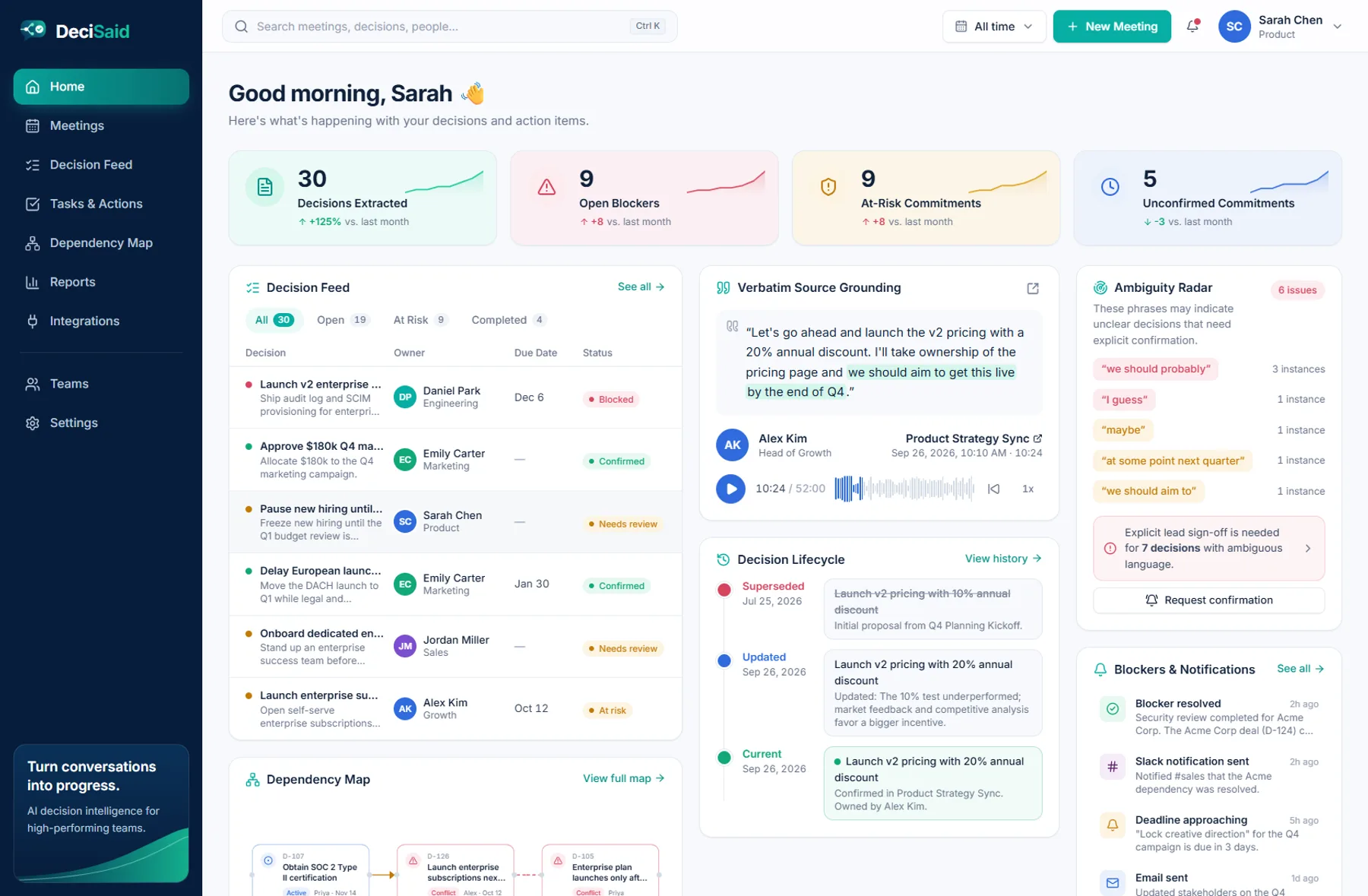
My latest project, still being built. Notes on keeping a decision useful long after the meeting that made it.
p. 01 — the idea
A decision should outlive the meeting.
DeciSaid is an AI decision-intelligence platform that transforms meeting transcripts and notes into structured, reviewable decisions. Each decision connects the original conversation to its owner, deadline, supporting evidence, dependencies, and follow-up actions.
Teams need to know why a decision exists, who owns it, what could stop it, and whether a later conversation changed it.
p. 02 — the problem
Notes capture words, not agreements.
“We should aim to launch next week” can look like a commitment even when no one accepted responsibility or confirmed a date. People leave the same meeting with different understandings.
Across meetings it gets worse: one team agrees a launch date while another discussion sets a prerequisite that makes it unrealistic — both buried in separate transcripts until delivery suffers.
p. 03 — the product approach
One connected chain, from talk to outcome.
Users submit a transcript or notes with meeting details. DeciSaid then streams its progress through each stage:
- parse the text
- extract candidate decisions & action items
- check for ambiguous language
- compare with workspace history
- assess execution risk
Each decision can carry a description, rationale, owner, deadline, confidence score, source quote, timestamp, related tasks and links to other decisions.
Missing information stays visible — so the team resolves it deliberately.
p. 04 — building trust through evidence
Every decision points back to what was actually said.
Alex Kim · Product Strategy Sync · 10:24“Let’s go ahead and launch the v2 pricing with a 20% annual discount. I’ll take ownership of the pricing page and we should aim to get this live by the end of Q4.”
- Source quotes are checked against the transcript.
- Output that can’t be grounded is re-anchored with lower confidence, or removed.
- Unknown owners, dates and rationale stay empty — never invented.
- Low confidence, high ambiguity or no owner → needs confirmation. Everything else starts as a draft.
p. 05 — ambiguity radar
Circle the hedges before they become misses.
Phrases like “maybe”, “we should aim to” or “someone from design” can signal unresolved intent, timing or ownership. Reviewers then confirm, reject, edit or request confirmation — ambiguity becomes a review queue. Try it:
Let's go ahead and launch the v2 pricing with a 20% annual discount. I'll take ownership of the pricing page and we should aim to get this live by the end of Q4.
→ 1 phrase to confirm: intent.
p. 06 — connecting decisions across meetings
The launch date that couldn’t happen.
Embeddings and similarity search find potentially related decisions in a workspace, then each pair is classified as a dependency, blocker, conflict, superseding decision or related item. In the sample scenario, “launch enterprise subscriptions next Monday” meets an earlier rule: the enterprise plan launches only after SOC 2 certification. An interactive graph lets users search, filter for blockers or conflicts, and open any record.
p. 07 — after the meeting
Track what happens next, and why.
Linked action items carry assignees, due dates, priorities and completion states. An append-only history records every change:
- confirmed
- owner changed
- deadline changed
- blocked
- completed
- reopened
- rejected
- superseded
When a prerequisite is completed, its dependents are checked. If every prerequisite is done, the decision is unblocked and its owner notified — in-app, plus Slack and email when configured.
p. 08 — explaining execution risk
A score from 0 to 100, with its reasons.
The reversal-risk engine reads signals, then explains them and recommends a fix — clarify a deadline, assign an owner, resolve a conflict.
- missing ownership
- vague deadlines
- unresolved prerequisites
- conflicts
- ambiguity
- owner workload
- unrealistic timing
- low extraction confidence
p. 09 — designing a connected workspace
Nine rooms, one drawer, one shortcut.
- Dashboard
- Meetings
- Decisions
- Dependencies
- Tasks
- Reports
- Teams
- Integrations
- Settings
The dashboard brings together decision activity, ambiguity, blockers, lifecycle changes, source grounding and risk. A shared decision drawer shows evidence, ownership, risk, relationships and history without leaving the current view.
The Ctrl K command palette searches meetings, decisions, tasks and people. Onboarding, sample data, empty and loading states carry the first-use experience.
p. 10 — engineering the platform
Services in boxes, a fallback for everything.
p. 11 — current scope & outcome
A working foundation — still being built.
The MVP connects transcript analysis to review, evidence, dependencies, risk, actions, history and notifications, with smoke tests and browser end-to-end scripts for key auth and workspace flows.
- Transcript → reviewable decisions
- Source grounding & Ambiguity Radar
- Dependency graph, risk & lifecycle
- Slack & email (when configured)
- Google Calendar — adapter built, OAuth to do
- Zoom / Teams / Meet — demo recordings
- Automated speech-to-text
— E.H.
Use the arrows, swipe, or the tabs to turn pages. Grab the red pen to mark things up.
{
  "React",
  "Three.js",
  "Express",
  "MySQL",
}A clearer view of the spaces where learning happens.